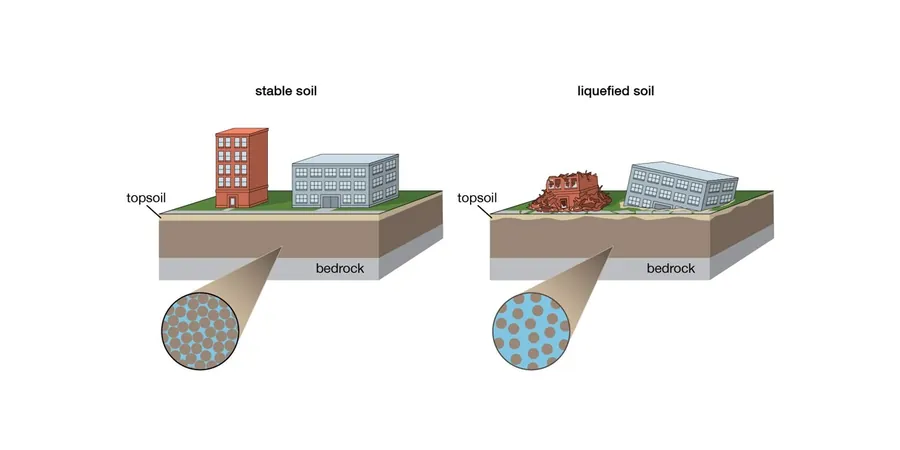
Modesto sits on deep alluvial deposits from the Tuolumne River, with groundwater typically between 3 and 12 feet below grade. These conditions — loose sands, silts, and a shallow water table — create a high potential for soil liquefaction during a seismic event. We evaluate this hazard using the NCEER/Youd-Idriss 2001 method, correlating corrected SPT blow counts with cyclic stress ratios. Before field work begins, we often pair this study with a seismic amplification analysis to understand how the entire soil column will behave under strong motion. The goal is simple: identify whether the ground will lose strength and how that affects your foundation design.
In Modesto, loose sands within 30 feet of the surface and a shallow water table make liquefaction the leading geotechnical concern for seismic design.
Methodology and scope
The geology beneath Modesto consists of young alluvial fan deposits from the Sierra Nevada — interbedded sands, gravels, and clayey silts with low plasticity. These strata often have relative densities below 50%, making them susceptible to cyclic softening. Our analysis follows the simplified procedure by Seed and Idriss, using SPT N-values corrected for overburden (N1_60) and fines content. We classify each borehole layer according to ASCE 7 site class, typically class D or E in this area. The output includes:
Factor of safety against liquefaction at each depth
Liquefaction potential index (LPI)
Post-liquefaction settlement estimates
All work is performed under ISO 17025-accredited procedures and references ASTM D1586-18 for field sampling.
Technical reference image — Modesto
Local considerations
The main risk in Modesto is differential settlement after liquefaction. A layer that liquefies at depth can cause the ground surface to settle unevenly, damaging slabs, footings, and underground utilities. We have seen cases where post-liquefaction settlements exceeded 6 inches in loose sandy zones near Dry Creek. That kind of movement can crack a foundation beyond repair. The challenge is that thin, non-liquefiable crusts can mask the hazard below — so we always recommend extending borings to at least 40 feet to capture the full profile.
Field SPT borings with continuous sampling, N1_60 correction, fines adjustment, and factor-of-safety profiles per Youd-Idriss 2001. Includes LPI and settlement estimates.
02
Shear Wave Velocity (Vs30) Profiling
MASW or seismic CPT to measure Vs30 for site class confirmation. Useful where SPT access is limited or for verifying liquefaction resistance in clean sands.
We calculate volumetric and deviatoric settlements using Tokimatsu-Seed and Ishihara methods. For lateral spread, we apply the multi-linear regression model by Youd et al. (2002).
Applicable standards
Youd & Idriss (2001) – NCEER liquefaction summary report, ASCE 7-16 – Site classification and seismic design, ASTM D1586-18 – Standard test method for SPT, ASTM D2487-17 – Unified soil classification system
Frequently asked questions
How much does a liquefaction analysis cost in Modesto?
A complete liquefaction study including two SPT borings to 40 feet, laboratory fines-content testing, and a written report with safety-factor profiles typically ranges between US$2,220 and US$4,560. The final price depends on the number of borings and the site's access conditions.
What is the difference between LPI and factor of safety?
Factor of safety (FS) is calculated for each soil layer individually. LPI integrates the severity and thickness of all liquefiable layers into a single index. In Modesto, LPI values above 15 often trigger ground improvement requirements.
Do I need a liquefaction study for a single-family home?
If your lot is in a seismic zone with shallow groundwater and loose sands — which covers most of Modesto — yes. The 2022 California Building Code (based on IBC) requires site-specific seismic hazard assessment for most new structures, including residential.
Can liquefaction be mitigated without deep foundations?
Yes. Shallow ground improvement methods like vibro-compaction, stone columns, or dynamic compaction can densify loose sands in the upper 20–30 feet. A proper liquefaction analysis tells you which method will work and to what depth.