The soil conditions near downtown Modesto differ sharply from those in the outlying Salida area. Downtown sits on deep alluvial deposits of the Tuolumne River floodplain, with soft clays and silty sands extending over 30 meters. Out toward the airport, older terrace deposits offer stiffer layers. For any tunnel project in Modesto, understanding these lateral variations is the foundation of safe design. A thorough geotechnical analysis for soft soil tunnels must capture the full profile, including groundwater behavior and the risk of piping through sandy lenses. Before finalizing the tunnel alignment, we often cross-reference findings with a geotechnical instrumentation plan to monitor real-time ground response during excavation.
The soft clays and loose sands of the Tuolumne floodplain demand a site-specific approach to tunnel face stability and long-term settlement control.
Methodology and scope
On many Modesto projects, we observe that the shallowest 8 to 12 meters contain interbedded soft clay and loose sand, a combination that complicates both face stability and settlement control. The geotechnical analysis for soft soil tunnels here must include high-quality undisturbed sampling using thin-wall Shelby tubes, followed by triaxial testing under undrained conditions. We also run consolidation tests to estimate long-term settlement. A key step is correlating SPT N-values with undrained shear strength using local correlations calibrated for Central Valley soils. When the tunnel alignment approaches existing utilities or bridge foundations, we recommend a separate vibrocompaction study to assess whether ground improvement is needed before tunneling begins.
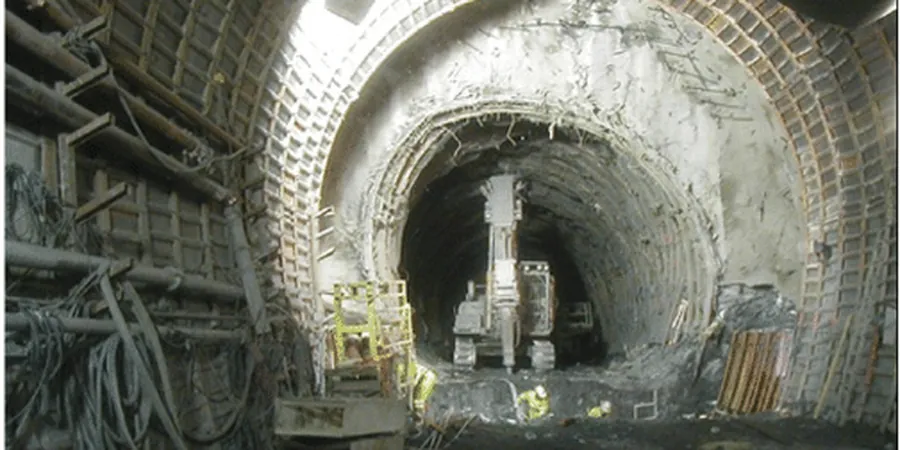
Technical reference image — Modesto
Local considerations
Modesto sits in an active seismic region, and the shallow groundwater table amplifies the risk of liquefaction during a major earthquake. For a tunnel in soft soil, liquefaction can cause lateral spreading, uplift of buried structures, or loss of bearing around shafts. The geotechnical analysis for soft soil tunnels must evaluate cyclic resistance ratios using specialized cyclic triaxial tests. We also model post-liquefaction reconsolidation settlements, which can exceed 30 cm in loose sand layers. Without this analysis, the tunnel lining could experience differential movements that crack the segmental rings or damage joints.
Boreholes to 35 m depth with SPT, undisturbed sampling, and in-situ vane shear. Laboratory testing includes consolidated-undrained triaxial, consolidation, and cyclic direct simple shear for seismic parameters.
02
Numerical Modeling & Risk Assessment
Finite element models (Plaxis 2D/3D) for tunnel face stability, lining forces, and ground settlement. Seismic hazard analysis per ASCE 7 with liquefaction triggering and post-shaking deformation estimates.
Applicable standards
ASTM D1586-18 (Standard Test Method for SPT), ASTM D2850-15 (Unconsolidated-Undrained Triaxial Test), ASCE 7-22 (Minimum Design Loads, Chapter 11: Seismic), FHWA-NHI-09-010 (Technical Manual for Design and Construction of Road Tunnels)
Frequently asked questions
How does the soft soil in Modesto affect tunnel excavation methods?
The soft clays and loose sands require closed-face Tunnel Boring Machines (TBMs) with earth pressure balance (EPB) to maintain face stability. The analysis provides key parameters like undrained shear strength and permeability that determine the TBM operating window and the need for ground conditioning.
What is the typical cost range for a geotechnical analysis for soft soil tunnels in Modesto?
A comprehensive study including field drilling, laboratory testing, and numerical modeling typically ranges between US$4,100 and US$15,500 depending on tunnel length, depth, and number of boreholes. Contact us for a scope-specific quote.
Is liquefaction a major concern for tunnels in Modesto?
Yes. The combination of loose sandy layers and a shallow water table (2–5 m deep) makes liquefaction a primary concern. We evaluate it using the NCEER method and cyclic triaxial tests, then model how excess pore pressure affects tunnel lining loads and potential flotation.
Which ASTM standards apply to soft soil tunnel investigations?
We follow ASTM D1586 for SPT, D2850 for undrained triaxial, D2435 for consolidation, and D5311 for cyclic tests. For seismic design, we reference ASCE 7-22 and the FHWA tunnel manual for performance criteria.