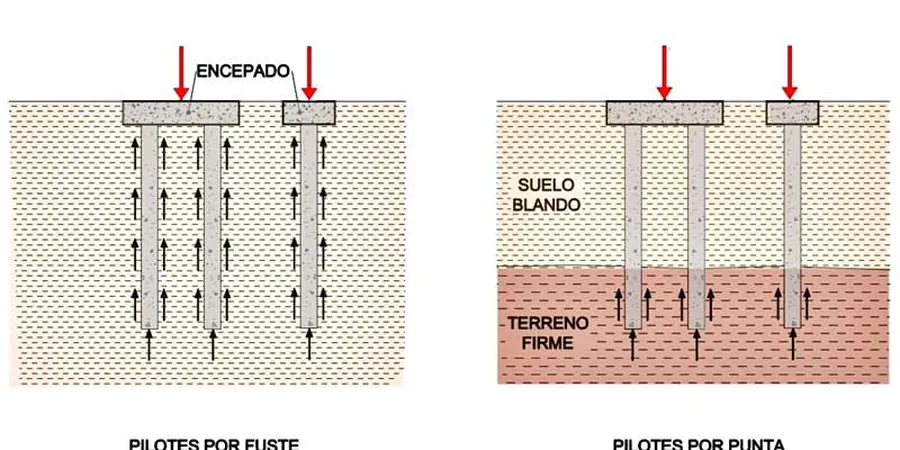
We worked on a six-story apartment complex near downtown Modesto where the geotechnical report initially recommended end-bearing piles driven to refusal. But after running a detailed pile skin friction vs. end bearing analysis on the actual soil profile — which includes stiff clays interbedded with dense sands — we found that skin friction alone could carry over 70% of the design load. That changed the pile length and saved the client significant costs. Before finalizing any deep foundation design, we always combine this analysis with a study of soil classification to confirm the stratigraphy and a pile load test review to calibrate our calculations against field conditions.
In Modesto's alluvial soils, skin friction often carries 60-80% of the design load — overlooking it means overdesigning piles by 10 feet or more.
Methodology and scope
The alluvial soils in Modesto's Central Valley create a tricky scenario for deep foundations. We typically encounter a 10 to 15-foot layer of stiff clay over dense sand and gravel, with groundwater around 20 feet deep. For the pile skin friction vs. end bearing analysis, we extract undisturbed samples and run direct shear tests on the clay-sand interface and triaxial compression on the sand layers. We then apply the alpha method for cohesive soils and the beta method for granular layers, both calibrated to local data. Each parameter feeds into a bearing capacity model that separates the shaft resistance from the tip resistance, so the design team knows exactly how much load each component carries. This analysis also informs whether vibrocompaction or other ground improvement might reduce required pile lengths.
Technical reference image — Modesto
Local considerations
A common mistake we see in Modesto is contractors designing piles based solely on end bearing in the dense sand layer, assuming the stiff clay offers negligible skin friction. That approach leads to over-designed piles that are 8 to 12 feet longer than necessary, driving up costs unnecessarily. Worse, if the clay layer is thicker than expected and the pile tip doesn't reach the dense sand, the foundation can settle unevenly. A proper pile skin friction vs. end bearing analysis accounts for both components and avoids these costly errors.
Bearing Capacity Calculation (Skin Friction + End Bearing)
We compute both shaft and tip resistance using site-specific soil parameters from SPT and lab tests, then provide a table of factored capacities for different pile diameters and lengths.
02
Pile Load Test Interpretation and Calibration
We review static load test results from your project, back-calculate the mobilized skin friction and end bearing, and adjust the design parameters for the remaining piles.
03
Ground Improvement Impact Assessment
If vibrocompaction or stone columns are considered, we model how the improved soil profile changes the skin friction and end bearing distribution, so you can optimize pile lengths.
Applicable standards
ASTM D1586-18 (Standard Test Method for SPT), ASTM D2487-17 (Standard Practice for Classification of Soils for Engineering Purposes), IBC 2021 Chapter 18 (Soils and Foundations), FHWA GEC 12 (Design and Construction of Driven Pile Foundations)
Frequently asked questions
What is the difference between skin friction and end bearing in pile design?
Skin friction is the load carried by the shaft of the pile through friction with the surrounding soil. End bearing is the load transferred through the pile tip to a strong layer beneath. In Modesto's alluvial soils, skin friction often contributes 60-80% of the total capacity in the upper sand and clay layers, while end bearing only becomes significant when the pile reaches the dense sand/gravel strata at 30-40 feet depth.
How much does a pile skin friction vs. end bearing analysis cost in Modesto?
For a typical project in Modesto, the analysis ranges between US$980 and US$2,860, depending on the number of soil borings, the complexity of the soil profile, and whether we need to run additional lab tests like triaxial or direct shear. This covers the calculation report and a discussion of the results with your design team.
When should I order this analysis instead of a standard pile capacity estimate?
Order a skin friction vs. end bearing analysis when the soil profile includes multiple layers with different strengths — exactly the case in Modesto where stiff clay overlies dense sand. Standard estimates often lump everything together, leading to overdesign. Our detailed analysis separates the contributions, so you can optimize pile length and save money. We recommend it for any project with more than 20 piles or where the soil profile varies significantly across the site.