In Modesto, where much of the urban development sits atop alluvial deposits from the Tuolumne River, understanding subsurface water flow is critical for project success. The local geology often features alternating layers of sands, silts, and clays, making groundwater control a central challenge during deep excavations and foundation construction. This is where a field permeability test (Lefranc/Lugeon) becomes indispensable — it directly measures the hydraulic conductivity of the soil or rock mass under in-situ conditions. Following ASTM D6391 and USBR 7310 standards, the test provides reliable data for dewatering design, dam embankment leakage assessment, and slope stability analysis. Before designing a drainage system or specifying a cutoff wall, this field permeability test in Modesto gives engineers the actual numbers they need rather than relying on conservative estimates from grain size correlations alone. The test also pairs well with an infiltration study when evaluating stormwater management solutions for commercial lots.
The in-situ permeability value directly governs dewatering pump sizing, drainage layer thickness, and cutoff wall depth — a single test can save weeks of construction delays.
Methodology and scope
A typical scenario we encounter involves a multi-story structure near downtown Modesto where the water table sits just 12 to 18 feet below grade. For such projects, the field permeability test (Lefranc/Lugeon) is conducted within a cased borehole, either as a constant head test (Lefranc) in permeable sands or a falling head test in less permeable silty layers. The procedure involves isolating a specific test section using packers, then measuring the flow rate under a steady hydraulic head. For rock masses encountered in deeper foundations, the Lugeon test variant applies stepwise pressure increments to characterize joint-controlled flow and identify potential grouting requirements. Our team records both flow rate and pressure at each stage, allowing calculation of permeability coefficients in cm/s or m/day. This data directly informs the design of temporary shoring systems and permanent drainage layers. Complementing this work with a georadar survey helps map subsurface anomalies that could affect test interpretation, while a classification of soils provides the grain-size context for the measured permeability values.
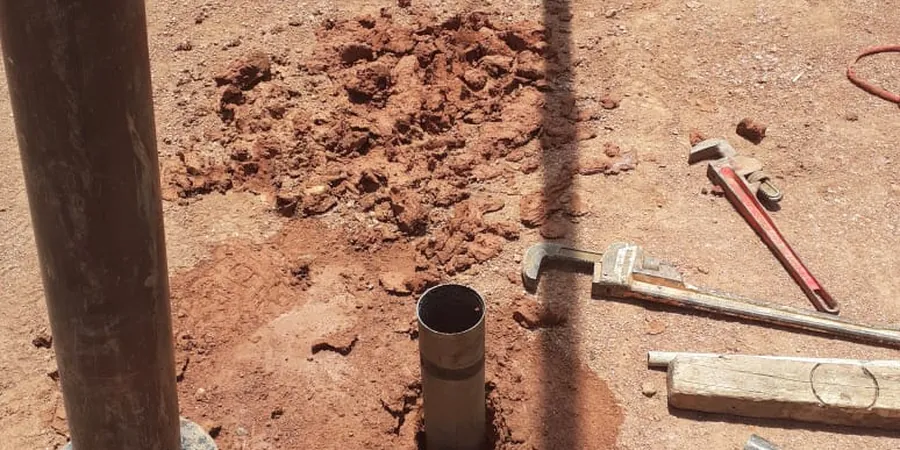
Technical reference image — Modesto
Local considerations
Modesto lies within the Central Valley, a region where irrigation practices have historically altered groundwater levels by tens of feet seasonally. This fluctuation means that a permeability test performed during a dry summer may yield significantly different results than one conducted after heavy winter rains. The risk is that foundation drainage systems designed without accounting for this variability may be undersized during high-water events. Furthermore, the presence of shallow confining layers can create perched water conditions that are invisible to standard monitoring wells. A properly conducted field permeability test in Modesto captures the actual flow behavior of each stratum, allowing engineers to model worst-case scenarios. For levees and canal embankments common in the area, this test is the only reliable way to assess internal erosion potential and seepage gradients that could lead to piping failure.
NX (3 inch) to HQ (3.8 inch) for soil; BQ to NQ for rock
Test section length
1.0 m to 3.0 m isolated via pneumatic packers
Pressure range (Lugeon)
Up to 10 bar, in 3 to 5 incremental steps
Applicable standards
ASTM D6391, USBR 7310, NF P94-132
Associated technical services
01
Lefranc Permeability Test (Constant & Falling Head)
Designed for soils and soft rocks, this test measures hydraulic conductivity in saturated or unsaturated conditions. The constant head variant is preferred for permeable sands where flow stabilizes quickly, while the falling head method suits silty clay layers with lower transmissivity. Results are reported as K-values in cm/s with full hydrostatic head corrections.
02
Lugeon Water Pressure Test
Applied in bedrock and cemented alluvium, this test injects water under controlled pressure stages to characterize joint-controlled permeability and grout take. The Lugeon value (1 Lugeon = 1 L/min/m at 10 bar) directly guides dam foundation treatment, tunnel support design, and cutoff wall specifications in Modesto's deeper strata.
Applicable standards
ASTM D6391-11 (Standard Test Method for Field Measurement of Hydraulic Conductivity Limits), USBR 7310 (Permeability Tests in Boreholes Using Packers), NF P94-132 (Lefranc Test in Soils and Soft Rocks)
Frequently asked questions
What is the difference between a Lefranc and a Lugeon test?
The Lefranc test is used in soils and soft rocks under low to moderate pressure, measuring hydraulic conductivity via constant or falling head. The Lugeon test applies stepped water pressures to rock masses to evaluate joint permeability and groutability. In Modesto, the Lefranc method is typical for shallow alluvial deposits, while the Lugeon test is reserved for deeper cemented gravels or bedrock foundations.
How long does a field permeability test take in Modesto?
A single Lefranc test at one depth interval typically takes 2 to 4 hours including setup, saturation, and steady-state flow monitoring. A Lugeon test with 5 pressure steps may require 4 to 6 hours per test section. Multiple intervals per borehole extend the total field time accordingly. Our team coordinates with the drilling schedule to minimize project delays.
What is the typical cost range for a field permeability test in Modesto?
The cost for a field permeability test in Modesto generally falls between US$620 and US$980 per test interval. This includes mobilization of packer equipment, on-site testing by a certified technician, and a detailed report with K-values and pressure-log plots. Volume discounts apply when testing multiple intervals across a single borehole.
Do I need a field permeability test if I already have grain size analysis?
Grain size analysis provides an estimated permeability range using empirical formulas like Hazen's, but it cannot account for in-situ fabric, layering, or fractures. In Modesto's heterogeneous alluvial soils, actual field permeability can differ from estimated values by an order of magnitude. The field test gives a direct measurement essential for dewatering design, seepage modeling, and regulatory compliance.