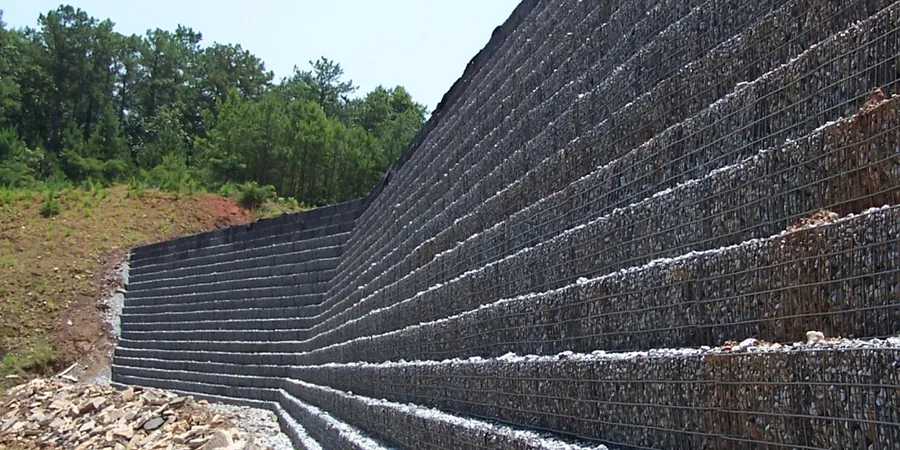
We were called to a site off Carpenter Road where a commercial development needed a 22-foot retaining wall. The owner wanted a reinforced concrete cantilever. We proposed an MSE wall instead. It saved time, reduced foundation excavation, and handled the soft alluvial soils better. That job in Modesto taught us something: MSE wall design here works well when you understand the local soil profile. The key is knowing how the reinforced fill interacts with the native ground. Before we specify reinforcement spacing or facing type, we run a full geotechnical study to classify the backfill and measure internal friction angles. That data drives every design parameter.
In Modesto, MSE wall design must account for seasonal moisture changes in the alluvial clay layers to prevent long-term drainage issues.
Methodology and scope
An MSE wall works as a gravity structure. The mass of the reinforced soil block resists overturning and sliding. We use galvanized steel strips or geogrids embedded in controlled fill. In Modesto, the challenge is the seasonal moisture variation. The clay layers shrink and swell, so we must design for long-term drainage and reinforcement durability. We always run permeability tests on the native clay to confirm that the wall drainage system won't saturate the reinforced zone. For walls over 30 feet, we also perform plate load tests on the foundation soil to verify bearing capacity under working loads. The facing panels are precast concrete, typically 1.5 meters wide, with leveling pads cast on compacted subgrade.
Technical reference image — Modesto
Local considerations
Modesto sits on the eastern edge of the San Joaquin Valley, where the soil profile is mostly alluvial clays and silts from the Tuolumne River floodplain. The water table sits at 15 to 30 feet, depending on the season. In winter, it rises. That means an MSE wall built in summer might have dry conditions below the base, but by February the foundation could be saturated. Poor drainage behind the wall leads to hydrostatic pressure buildup, which can bulge the facing or tilt the wall. We mitigate this with a gravel drainage blanket and a perforated pipe at the base, tied into the site stormwater system. In seismic zones like this, the reinforced soil mass must also resist acceleration forces without losing internal integrity.
Complete structural design of MSE walls using geogrid or steel strip reinforcement. We calculate internal stability, external sliding, overturning, and bearing capacity per AASHTO LRFD. Suitable for walls up to 40 feet.
02
Bridge Abutment MSE Systems
Integrated MSE abutment design for bridge approaches. We coordinate the wall geometry with the bridge seat, approach slab, and wing walls. Includes seismic load analysis per ASCE 7 for Modesto's site class.
03
Slope Stabilization with MSE
Reinforced soil slopes for repairing landslide areas or widening embankments. We design the reinforcement layout to increase factor of safety against rotational and translational failure. Uses geogrid and compacted fill.
Applicable standards
AASHTO LRFD Bridge Design Specifications (9th Ed., 2020), ASCE 7-22 Minimum Design Loads and Associated Criteria for Buildings and Other Structures, IBC 2021 Chapter 18 – Soils and Foundations, ASTM D1586-18 Standard Test Method for Standard Penetration Test (SPT)
Frequently asked questions
What is an MSE wall and how does it work?
An MSE (Mechanically Stabilized Earth) wall is a retaining structure where layers of reinforcement — steel strips or geogrids — are placed within compacted granular fill. The reinforced soil block behaves as a gravity mass, resisting overturning and sliding. Facing panels or wraps hold the soil in place.
What soil conditions affect MSE wall design in Modesto?
Modesto's alluvial clays and silts have moderate bearing capacity but high shrink-swell potential. The water table fluctuates seasonally, so drainage design is critical. We always assess the native clay's plasticity index and determine the in-situ moisture content before finalizing reinforcement spacing.
How much does MSE wall design cost in Modesto?
Typical design fees for an MSE wall in Modesto range between US$1,290 and US$4,060 depending on wall height, length, and complexity. This includes site-specific reinforcement calculations, drainage design, and seismic analysis. Additional testing like plate load or permeability may add cost.
What seismic design factors apply to MSE walls in Modesto?
Per ASCE 7-22, Modesto falls in Seismic Design Category D with a site-adjusted spectral acceleration (SDS) around 0.30g. We apply the Mononobe-Okabe method to calculate dynamic active pressure and check internal stability under seismic loading. Reinforcement strength must be increased accordingly.