A common mistake we see from contractors in Modesto is assuming that a generic seismic map from the IBC applies uniformly to every parcel. The Central Valley geology here is far from uniform — interbedded sands, silts, and clays create dramatic variations in shear wave velocity over short distances. Without a site-specific seismic amplification analysis, your design may either overestimate or underestimate the actual ground motion, leading to either wasted reinforcement or unsafe detailing. That is why we always pair the amplification study with a georradar survey to map shallow stratigraphy and a clasificación de suelos to confirm the Unified Soil Classification System group before running any numerical model.
In Modesto, the difference between a Site Class C and a Site Class D can shift the spectral acceleration by 30 percent, directly impacting reinforcement quantities and footing dimensions.
Methodology and scope
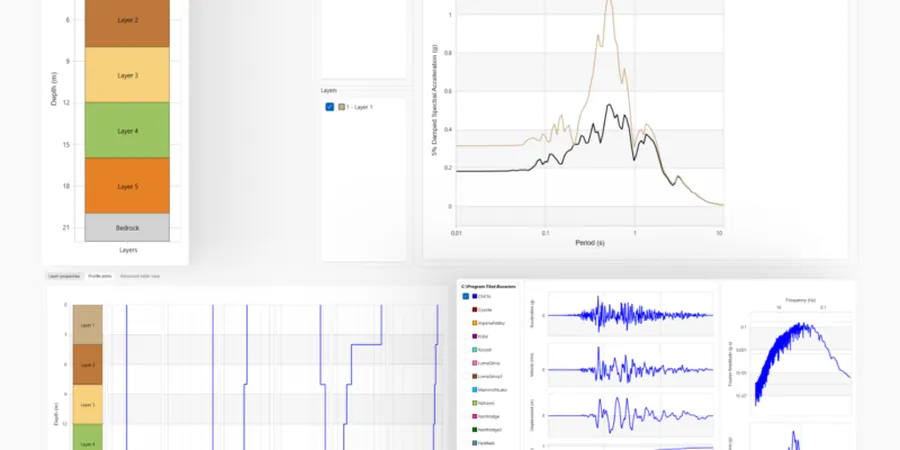
We follow ASCE 7-22 Chapter 20 procedures for site class determination, which in Modesto often lands on Class D or even Class E due to the thick Holocene alluvium. The key parameter we measure is the time-averaged shear-wave velocity to 30 meters (VS30), using either MASW or ReMi arrays. For soft-soil sites near the Tuolumne River floodplain, we also perform 1D equivalent-linear ground response analysis using programs like DEEPSOIL or STRATA. The output includes acceleration response spectra at the surface, amplification factors, and depth-dependent shear strain profiles. When the project involves deep foundations, we cross-reference the results with a licuefaction assessment to evaluate cyclic softening potential under the amplified motion.
Technical reference image — Modesto
Local considerations
Modesto sits atop the Great Valley Sequence, a deep sedimentary basin exceeding 500 meters of unconsolidated deposits in places. During a seismic event on the San Andreas or Hayward faults, these soft soils can amplify long-period motions by a factor of two or more compared to a rock site. The greatest danger is resonance between the building's natural period and the amplified ground motion, which we have seen cause non-ductile failures in two-story commercial structures. Performing a proper seismic amplification analysis early in design allows the engineer to tune stiffness and damping to avoid that resonance band.
Multi-channel Analysis of Surface Waves to measure shear-wave velocity down to 30 meters. We deploy 24 geophones along 70-meter lines, processing through SeisImager for 1D and 2D velocity sections.
02
1D Equivalent-Linear Ground Response
Using DEEPSOIL v7.0 with site-specific modulus reduction and damping curves (Darendeli 2001). Output includes surface acceleration time histories, response spectra, and amplification ratios for MCE and DBE levels.
03
Seismic Design Report for Permitting
Comprehensive report summarizing site class determination, spectral accelerations, and recommendations for foundation type and structural ductility. Ready for submittal to Stanislaus County Building Department.
What is the difference between site class and seismic amplification analysis?
Site class is a single categorical label (A through F) based on VS30, while seismic amplification analysis quantifies how much the ground motion increases as it propagates through the soil column. Two sites with the same site class can have very different amplification factors depending on the shear-wave velocity profile and the frequency content of the input motion.
How much does a seismic amplification analysis cost for a typical Modesto project?
For a typical commercial lot in Modesto, the cost ranges between US$900 and US$2,200. This includes field MASW survey, laboratory correlation, 1D equivalent-linear modeling, and a formal report. Larger parcels or multi-building campuses increase the price due to additional MASW lines.
Do I need a seismic amplification analysis for a single-family home in Modesto?
California Building Code (CBC) does not require a site-specific analysis for one- and two-story wood-frame homes on Site Class D or better. However, if the home is located in a floodplain zone (FEMA AE) where soft soils exceed 10 meters depth, a simplified VS30 measurement is advisable to confirm the site class and avoid excessive foundation costs.
What software and methods do you use for the 1D analysis?
We use DEEPSOIL v7.0 for equivalent-linear and linear analyses, with strain-compatible modulus reduction and damping curves from Darendeli (2001). Input motions are scaled to the ASCE 7 target spectrum using the NGA-West2 database. For verification, we sometimes cross-check with STRATA for the same soil column.